
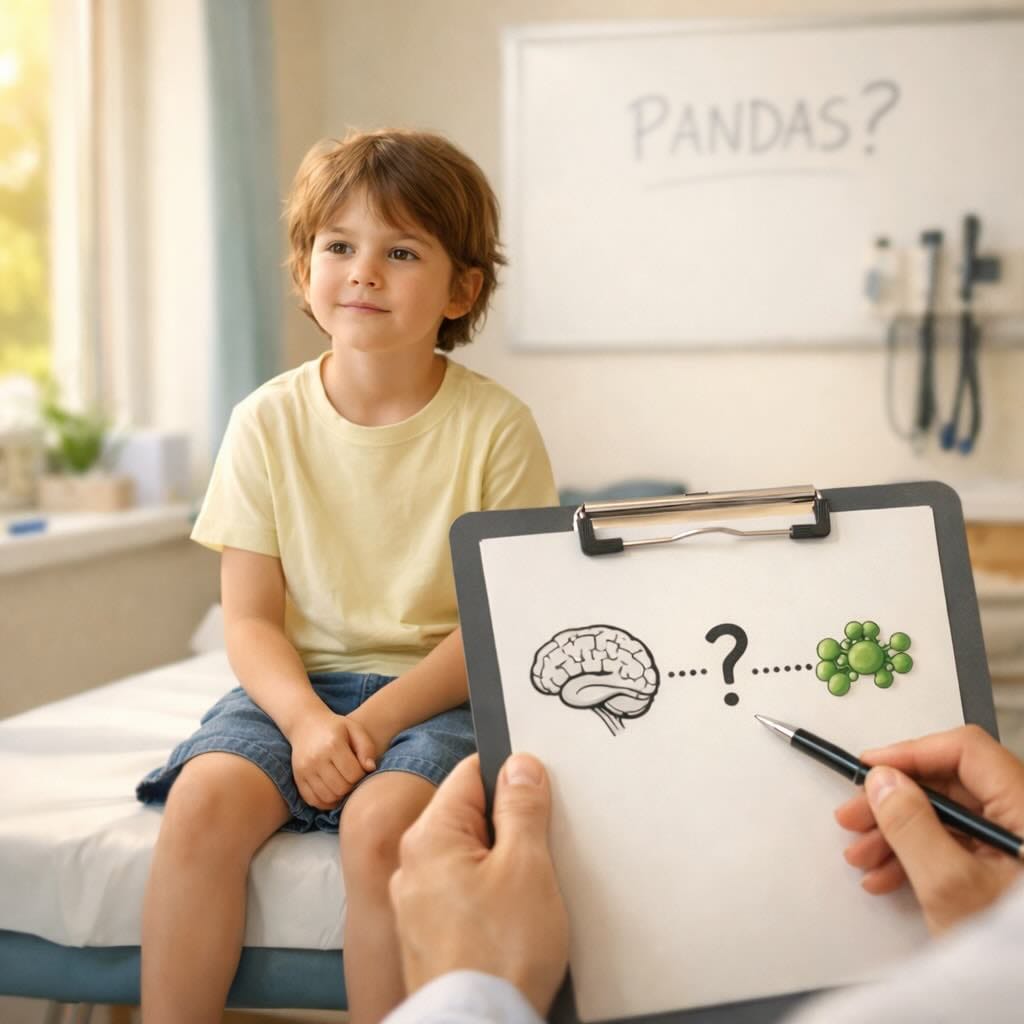
PANDAS, Tics & ADHD:
What the Research Actually Shows
An honest, in-depth guide for parents — covering the true incidence, the official diagnostic criteria, and why over-diagnosis is causing real harm to South African families.
After 25 years working with families across KwaZulu-Natal, something is happening in our medical community that I feel compelled to address directly. Children with ADHD and motor tics are regularly being diagnosed with a rare condition called PANDAS. Families are spending significant money on tests and treatments they do not need — while the interventions that would genuinely help their child are delayed, sometimes by years.
This guide is built on actual published research. Not opinions — real studies, with real numbers. Because when a doctor tells you your child has PANDAS, you deserve to know whether the evidence genuinely supports that conclusion.
What Is PANDAS?
PANDAS stands for Paediatric Autoimmune Neuropsychiatric Disorders Associated with Streptococcal infections. It describes a condition where a strep infection — the same bacteria that causes strep throat — triggers an unusual immune response. In a small number of children, the immune system appears to mistakenly attack areas of the brain, particularly the basal ganglia, producing sudden and dramatic changes in behaviour, mood, and movement.
The critical word in that description is sudden. True PANDAS does not creep in gradually over a school term. It does not mean a child who has always been intense is now a little worse. Parents of children with genuine PANDAS can usually tell you the specific week — sometimes the specific day — that everything changed. That clarity of onset is the defining clinical fingerprint of this condition.
There is also a broader category called PANS (Paediatric Acute-onset Neuropsychiatric Syndrome) — similar in presentation but potentially triggered by infections other than strep, or by other environmental factors. For this guide I will focus on PANDAS, as it is the diagnosis most commonly applied — and misapplied — in children with ADHD and tics.
Whenever PANDAS is mentioned, ask three questions: Was the onset sudden? Can the parents identify a specific week or day? Was there a confirmed strep infection immediately beforehand? If the answer to any of these is no or uncertain, the PANDAS diagnosis deserves very careful scrutiny.
How Common Is It, Really?
This is where honest medicine begins. Not with anecdote, not with clinical impression — but with numbers from properly conducted research.
In 2023, Wald and colleagues published a landmark study in Frontiers in Pediatrics. They studied 95,498 children across three major academic medical centres over three years. Every child who might possibly have PANDAS or PANS was carefully identified, and the formal diagnostic criteria were applied rigorously to each case.
Out of nearly one hundred thousand children, they identified 13 genuine cases. The calculated annual incidence was 1 child in every 11,765 between the ages of 3 and 12. The authors described PANDAS/PANS as “a rare disorder with substantial heterogeneity.”
Now let’s place that number next to the conditions far more likely to explain ADHD and tics:
Sources: Wald et al. 2023; Jafari et al. 2022; Scharf et al. 2014. Full references at end of article.
“If your child has ADHD and motor tics, the probability that PANDAS is the explanation is roughly 800 times smaller than the probability that ADHD with tics explains it.”
— This is mathematics, not opinion. It should be the starting point of every diagnostic conversation.When a clinician diagnoses PANDAS in children with ADHD and tics at the frequency I am currently seeing in our community, they are not applying sound statistical reasoning to the clinical picture. They are working backwards from a favoured conclusion. The consequences for families — financial, emotional, and medical — are serious and real.
The Five Official Diagnostic Criteria
PANDAS was first formally described by Dr Susan Swedo and colleagues at the US National Institute of Mental Health in 1998. Five specific criteria were established, and all five must be present for a valid diagnosis. This is not a case of matching a few features. Every criterion is required.
The obsessions, compulsions, or tics must be severe enough to meet the full clinical criteria for OCD or a diagnosed tic disorder. They must significantly interfere with daily functioning. ADHD alone, anxiety alone, or general behaviour changes alone do not qualify.
Symptoms must first appear between the ages of 3 years and puberty. Onset after puberty effectively excludes PANDAS from consideration.
This is the defining criterion. The onset must be abrupt and unmistakeable. Parents must be able to name a specific week — often a specific day. Not gradually worse over months. Not a difficult school term. Researchers specifically use the phrase “explosive onset.” If parents cannot clearly date the change, this criterion is not met.
A confirmed, documented Group A streptococcal infection must have a clear temporal relationship to the symptom onset. A single elevated blood antibody result is not sufficient. A confirmed active infection, or a demonstrated fourfold rise in antibody levels between two sequential tests, is required.
Specific neurological features including choreiform movements (small, irregular jerky movements when standing with arms outstretched), hyperactivity, emotional lability, and sensory sensitivities — all appearing suddenly alongside the primary symptoms.
True PANDAS follows a relapsing-remitting pattern. Symptoms flare dramatically with each new strep infection and genuinely improve between episodes. If your child’s difficulties are constant and chronic rather than clearly episode-linked, PANDAS is not the correct explanation — regardless of how elevated a single blood test appears.
Understanding the Blood Tests
The ASO Test — What It Can and Cannot Tell You
The ASO (anti-streptolysin O) test measures antibodies produced in response to strep infection. An elevated result is frequently cited as diagnostic evidence for PANDAS. It is not. Understanding this distinction is one of the most important things in this entire guide.
-
Strep is extremely common in children. Most school-age children have one or more strep infections every year. Antibodies remain elevated for weeks to months after each infection. An elevated ASO often simply means your child recently had strep throat — which is entirely normal.
-
Normal levels are higher in children than adults. Reference ranges are often based on adult data. What appears “elevated” in a child may actually be within the normal range for their age.
-
56% of wrongly diagnosed children also had elevated ASO. Research (Dop et al., 2020) found that more than half of children who were misdiagnosed with PANDAS had elevated strep antibodies. A single positive result does not confirm PANDAS — it confirms a recent strep exposure, which is unremarkable in a school-age child.
What Proper Testing Looks Like
If PANDAS is genuinely being considered based on the full clinical picture, correct testing requires sequential sampling over time:
- A throat swab — both rapid test and 48-hour culture
- A perianal swab if throat swabs are negative (strep can persist there with minimal symptoms)
- A baseline ASO level at the time of symptom onset
- A second antibody test 6–8 weeks later, looking for a fourfold rise between the two samples
- This documented rise is what provides meaningful evidence of a causal strep infection
The Cunningham Panel
The Cunningham Panel is a commercially available test measuring antibodies against specific brain proteins. It is not validated as a diagnostic test for PANDAS by international medical organisations. It carries a meaningful false-positive rate in children with ADHD, OCD, and Tourette’s syndrome. It is not included in formal PANDAS diagnostic criteria and is not covered by most South African medical aids. It is a research tool being marketed as a clinical one, and families are making significant financial decisions based on results that clinicians may be poorly equipped to interpret.
PANDAS vs ADHD With Tics vs Tourette’s Syndrome
This table is one of the most practically useful things in this guide. Use it to think clearly about what your child’s clinical picture actually looks like, and where the evidence genuinely points.
| Feature | ADHD With Tics | Tourette’s Syndrome | True PANDAS |
|---|---|---|---|
| How it starts | Gradual, over months to years | Gradual, onset typically age 5–7 | Sudden — parents identify the exact week or day |
| Prevalence | ~1 in 5 children with ADHD | ~1 in 150–175 children | 1 in 11,765 children per year |
| Infection link? | None required | None required | Confirmed strep required — elevated ASO alone is insufficient |
| OCD features? | Mild or absent | Moderate, part of broader pattern | Prominent and sudden — dominates the presentation |
| Course over time | Chronic, fluctuates with stress | Improves through the teenage years in most cases | Episodic — flares with each strep, improves between |
| Family history? | Often ADHD in close family | Strong genetic loading for tics | Not a required feature |
| Emotional changes? | ADHD-related, gradual, familiar pattern | Related to OCD and anxiety features | Extreme and sudden — dramatically out of character |
| Choreiform movements? | Not a feature | Not typical | Characteristic — small jerky movements with arms outstretched |
The Unmasking Effect — Why Tics Appear After Starting Medication
This is one of the most common concerns I hear from parents. Their child starts ADHD medication, and tics suddenly become visible. Parents understandably worry the medication caused them.
The tics were almost certainly already present — hidden by the constant background noise of hyperactive movement. When medication reduces the general activity level, the tics become visible against a calmer backdrop. This is the unmasking effect, and it is well-documented in the literature.
It does not mean the medication caused the tics. It does not suggest PANDAS. It means the medication is working, and what was always there can now be seen clearly. In most cases the tics remain mild, do not interfere significantly with daily life, and often reduce naturally over time.
When Should PANDAS Actually Be Investigated?
Here is my honest clinical answer, grounded in the evidence from 25 years of practice. Pursue a genuine PANDAS investigation only when all of the following are clearly present:
-
Sudden, precisely-dated onset. Parents can name the specific week — not a gradual decline, but a dramatic change within days. The child was neuropsychiatrically stable immediately before.
-
Prominent OCD features. Intrusive thoughts, compulsive rituals, intense irrational fears, or sudden regression in previously mastered skills — appearing suddenly and dominating the clinical picture.
-
Documented strep infection. A confirmed positive throat culture, perianal swab, or a demonstrated fourfold rise in ASO or anti-DNase B antibodies between two sequential samples at the correct intervals.
-
Other conditions genuinely excluded first. ADHD with tics, Tourette’s syndrome, anxiety disorder, OCD, autism spectrum, and other neurological explanations have been carefully assessed and confidently excluded.
-
Referral to the right specialist. Assessment led by a paediatric neurologist or a paediatrician with specific neuropsychiatric expertise — not managed solely in a general practice setting.
- The onset was gradual, not sudden and dramatic
- There is no confirmed strep infection — only a single elevated ASO on one blood test
- The diagnosis is based primarily on the child having ADHD and tics
- OCD features are absent, mild, or developed gradually over time
- Tourette’s syndrome and ADHD with tics were not properly assessed and excluded first
Why Are Some Clinicians Getting This Wrong?
I want to address this fairly, because the answer is rarely as simple as poor practice. PANDAS is genuinely difficult to diagnose correctly. It requires a detailed developmental and infection history, sequential testing over weeks, and careful exclusion of far more common conditions first. In a busy consulting room with a distressed family, the pressure to offer an explanation is real and human.
PANDAS offers several things that are psychologically compelling in that moment: a specific medical cause, an active treatment that feels decisive, and a story that can reduce parental guilt by attributing a child’s struggles to something external — an infection — rather than a neurological difference.
- Provides a specific, external medical cause
- Antibiotics feel decisive and active
- Removes the weight of a neurological difference label
- Antibiotics carry real gut and resistance risks
- Intensive immune treatments carry far greater risks
- Every month on the wrong path delays what would genuinely help
The PANS Research Consortium, publishing in the Journal of Child and Adolescent Psychopharmacology, was explicit in its 2017 guidelines: immunological treatments should be reserved only for cases with clearly confirmed neuroinflammation or post-infectious autoimmunity. For mild or uncertain presentations, the first-line recommendation is watchful waiting combined with cognitive behavioural therapy — which, interestingly, overlaps significantly with what we would recommend anyway for ADHD with OCD features or Tourette’s syndrome.
If Your Child Has Already Been Diagnosed
If your child has received a PANDAS diagnosis and something about it doesn’t sit right with you, you are not being ungrateful or difficult. You are exercising exactly the judgement a good parent should.
Consider a Second Opinion If:
- The onset of symptoms was gradual, not sudden and dramatic
- There was no confirmed strep infection — only an elevated ASO on a single blood test
- The diagnosis was reached primarily because your child has ADHD and tics
- OCD features are absent or mild, and developed gradually
- Tourette’s syndrome and ADHD with tics were not properly assessed before the PANDAS conclusion was reached
Write down your child’s timeline: when did symptoms first appear, how quickly did they develop, and can you name a specific week? Write down the infection history: was there a confirmed strep infection immediately beforehand? Note whether genuine OCD features are present and prominent, or absent and mild.
Take this written summary to a paediatric neurologist or a paediatrician specialising in neurodevelopmental conditions for a second opinion. A second opinion does not invalidate your child’s difficulties. It protects them from treatment they may not need, and it ensures they receive the help they actually do need.
Rare conditions are rare.
That is not a dismissive statement — it is the foundation of sound clinical reasoning, and the starting point of every honest medical conversation.
PANDAS is a real condition. In the children who genuinely have it, correct diagnosis and appropriate treatment genuinely matter. The problem is not that PANDAS exists. The problem is that its very specific, unmistakeable clinical fingerprint is being applied to children who have common, well-understood, treatable neurodevelopmental conditions.
Your child with ADHD and tics is not a diagnostic puzzle requiring a rare autoimmune explanation. They have a well-characterised neurological profile that we understand clearly, can explain to your family, and can address effectively with the right support.
Getting that right — and getting your child onto the correct path as early as possible — is what transforms confusion into clarity, shame into strategy, and exhaustion into genuine empowerment. Your child’s brain isn’t broken. It’s wired differently. And that changes everything.
References & Research Sources
10 peer-reviewed sourcesAll claims in this article are grounded in peer-reviewed research published in international medical journals. The DOI links below take you directly to the original published source, where you can verify the findings independently. Parents deserve to see the evidence, not just conclusions.
-
01Wald ER, Eickhoff J, Flood GE, et al. Estimate of the incidence of PANDAS and PANS in 3 primary care populations. Frontiers in Pediatrics. 2023;11:1170379. The most rigorous incidence study to date — 95,498 children, 13 confirmed cases.
doi: 10.3389/fped.2023.1170379 -
02Gamucci A, Uccella S, Sciarretta L, et al. PANDAS and PANS: Clinical, Neuropsychological, and Biological Characterization and Proposal for a Diagnostic Protocol. Journal of Child and Adolescent Psychopharmacology. 2019;29(4):305–312.
doi: 10.1089/cap.2018.0087 -
03Frankovich J, Swedo S, Murphy T, et al. Clinical Management of Pediatric Acute-Onset Neuropsychiatric Syndrome: Part II — Use of Immunomodulatory Therapies. Journal of Child and Adolescent Psychopharmacology. 2017;27(7):574–593. International consensus guidelines from the PANS Research Consortium.
doi: 10.1089/cap.2016.0148 -
04Thienemann M, Murphy T, Leckman J, et al. Clinical Management of Pediatric Acute-Onset Neuropsychiatric Syndrome: Part I — Psychiatric and Behavioral Interventions. Journal of Child and Adolescent Psychopharmacology. 2017;27(7):566–573.
doi: 10.1089/cap.2016.0145 -
05Dop D, Marcu IR, Padureanu R, Niculescu CE, Padureanu V. Pediatric autoimmune neuropsychiatric disorders associated with streptococcal infections (Review). Experimental and Therapeutic Medicine. 2020;21(1):94. Documents the 56% false-positive ASO finding in misdiagnosed children.
doi: 10.3892/etm.2020.9526 -
06Baj J, Sitarz R, Forma A, Wroblewska K, Karakula-Juchnowicz H. Alterations in the Nervous System and Gut Microbiota after Beta-Haemolytic Streptococcus Group A Infection — Characteristics and Diagnostic Criteria of PANDAS Recognition. International Journal of Molecular Sciences. 2020;21(4).
doi: 10.3390/ijms21041476 -
07Calaprice D, Tona J, Parker-Athill EC, Murphy TK. A Survey of Pediatric Acute-Onset Neuropsychiatric Syndrome Characteristics and Course. Journal of Child and Adolescent Psychopharmacology. 2017;27(7):607–618. Survey of 698 patients with clinical PANS diagnoses.
doi: 10.1089/cap.2016.0105 -
08Jafari F, Abbasi P, Rahmati M, Hodhodi T, Kazeminia M. Systematic Review and Meta-Analysis of Tourette Syndrome Prevalence: 1986 to 2022. Pediatric Neurology. 2022;137:6–16. Meta-analysis of 30 studies on global Tourette’s syndrome prevalence.
doi: 10.1016/j.pediatrneurol.2022.08.010 -
09Scharf JM, Miller LL, Gauvin CA, et al. Population prevalence of Tourette syndrome: a systematic review and meta-analysis. Movement Disorders. 2014;30(2):221–228. Analysis of 26 studies; pooled prevalence estimate 0.52%.
doi: 10.1002/mds.26089 -
10Brown K, Farmer C, Farhadian B, et al. Pediatric Acute-Onset Neuropsychiatric Syndrome Response to Oral Corticosteroid Bursts: An Observational Study. Journal of Child and Adolescent Psychopharmacology. 2017;27(7):629–639.
doi: 10.1089/cap.2016.0139
All references can be verified at pubmed.ncbi.nlm.nih.gov — search the DOI number or article title to access the original publication.