
ADHD Medication

0.0 (0)
By john
This course is currently closed
Status
Not Enrolled
Lesson
10
Enrolled
0
Progression
Linear
Update
March 13, 2026
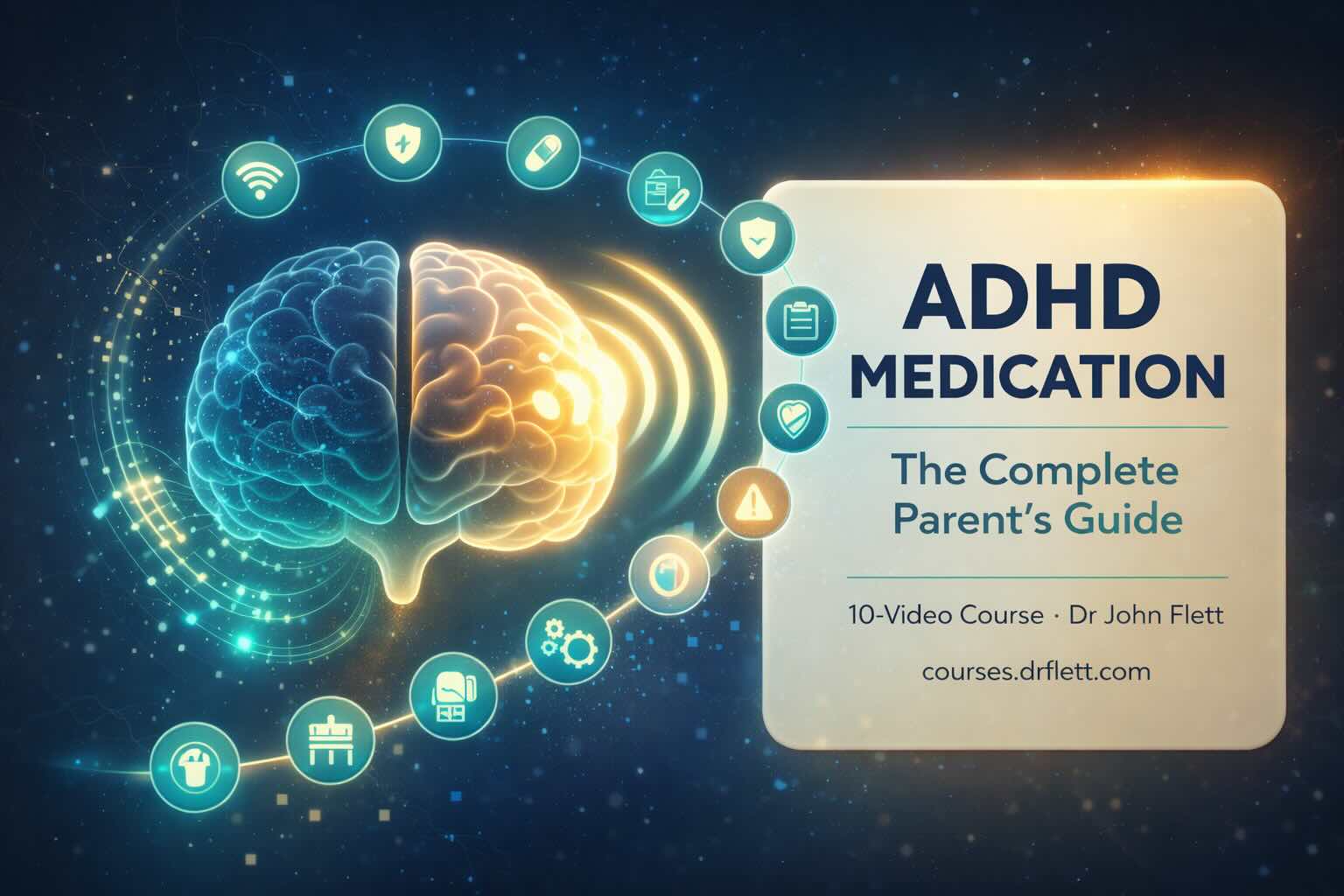
ADHD Medication: The Complete Parent’s Guide β€” Dr John Flett
Complete Course Β· 10 Videos

ADHD Medication:
The Complete Parent’s Guide

Everything you need to know β€” explained clearly, honestly, and without jargon

10 videos Β· ~80 minutes
10 companion guides included
Dr John Flett Β· MBChB BSc(Hons) MRCP(UK) FCP(Paed)(SA)

If your child has been diagnosed with ADHD, medication is almost certainly part of the conversation. This course is designed to give you genuine understanding β€” how medication works in your child’s brain, what it can and cannot do, and how to get the very best from treatment as an informed, confident partner in your child’s care.

Clinically accurate
Parent-friendly language
No jargon, no fear-mongering
Practical tools at every step
25+ years of clinical experience

From confusion to clarity β€” for good

By the time you complete this course, you will understand your child’s medication the way a knowledgeable, engaged parent should β€” not to second-guess your doctor, but to become their most valuable partner.

🧠

How medication actually works

Understand the brain chemistry behind ADHD medication β€” in plain English, with an analogy you’ll never forget.

βš–οΈ

Realistic expectations

Know exactly what medication can and cannot do, so you avoid the most common disappointment families face.

πŸ’Š

Your medication options

Navigate the three medication families with confidence β€” methylphenidate, amphetamines, and non-stimulants explained clearly.

πŸ“‹

How to start a proper trial

Understand titration, what to observe, and how to give medication a fair chance β€” not judge it by day three.

πŸ”

Side effects β€” managed, not feared

Every common side effect explained honestly, with practical solutions and a clear line between expected and unacceptable.

πŸ“Š

How to know if it’s working

A simple system for structured observation that gives your prescriber exactly what they need to optimise treatment.

🧩

The bigger picture

See how medication fits into the Four-Leg Table β€” and understand why the other three legs matter just as much.

🀝

Confidence with your prescriber

Walk into every appointment informed, prepared, and ready to ask the right questions at the right time.


10 videos that build real understanding

10 videos Β· ~80 min total
1
The Wi-Fi Booster
What Medication Actually Does Inside Your Child’s Brain
Your child’s brain is a supercomputer β€” creative, fast, and capable. But right now, the Wi-Fi signal keeps dropping. Medication is the booster. This video explains exactly how dopamine and norepinephrine work, why the ADHD brain struggles to keep the signal connected, and how stimulant medication addresses that β€” without changing who your child is.
~6:30
πŸ›œ Wi-Fi Booster
2
What Medication Doesn’t Do
And Why That Matters More Than You Think
Medication carries approximately 40% of the solution. It creates the conditions for learning, connection, and growth β€” but it doesn’t automatically produce them. This is the video that protects you from the most common disappointment parents face after starting treatment.
~6:30
πŸͺ‘ Four-Leg Table
3
Your Medication Options
A Plain-English Guide to What’s Available
Ritalin. Concerta. Vyvanse. Strattera. It can feel like a maze. It isn’t. There are three families β€” methylphenidate, amphetamines, and non-stimulants β€” and by the end of this video, you’ll understand all of them, how they differ, and how to have an informed conversation with your prescriber.
~7:00
πŸ’‘ Three Families
4
Starting Medication
What a Proper Trial Actually Looks Like
Starting medication is not “give a pill and see what happens.” It follows a structured process: start low, go slow, observe systematically. The starting dose is almost never the final dose β€” and a fair trial means reaching the optimised dose, not judging by day three.
~7:00
πŸ“ˆ Titration
5
Side Effects
The Honest Conversation Every Parent Needs
Side effects are real. Reduced appetite at lunchtime. Sleep that takes longer to come. The four o’clock rebound. Every one of them has a solution. This video gives you the complete honest picture β€” and draws a clear line between side effects that are manageable and the one that is never acceptable.
~7:00
⚠️ Side Effects
6
The Coverage Question
Why ADHD Doesn’t Stop at 3pm
The medication works brilliantly at school. But by 4pm, it’s chaos. ADHD doesn’t clock off when the school day ends. This video introduces the backbone-and-booster strategy β€” the approach that gives families their evenings back without disrupting sleep.
~6:30
πŸ•“ Coverage Gap
7
Is It Working?
The Seven Dials That Tell You Medication Is Doing Its Job
Your prescriber sees your child for 15 minutes. You see them every day. Structured observation across seven executive function areas β€” the Pause Button, the School Bag, the Volume Dial, and more β€” turns vague impressions into actionable data your prescriber can actually use.
~6:30
πŸŽ›οΈ Seven Dials
8
When It’s Not Just ADHD
The Conditions That Travel Alongside
80% of children with ADHD have at least one additional condition. If your child is on well-managed medication and still struggling significantly, the medication hasn’t failed. There may be an invisible passenger β€” anxiety, a learning difficulty, depression, or disrupted sleep β€” that needs its own attention.
~6:30
πŸŽ’ Co-occurring Conditions
9
Beyond Stimulants
When Your Child Needs Teammates
Adding a second medication isn’t a sign of failure β€” it’s a sign that treatment is being refined. Different medications target different brain systems. SSRIs for anxiety. Melatonin for sleep. Clonidine for hyperarousal. Different instruments, same orchestra β€” and the music is better for it.
~6:30
🎻 The Orchestra
10
The Complete Picture
Bringing It All Together with the Four-Leg Table
The final video ties everything together. Medication is the strongest single leg of the table β€” but a table cannot stand on one leg. You’ll leave this course knowing not just how to manage medication, but how it fits into the complete treatment picture β€” and with a practical audit to find where your child needs support most.
~7:00
πŸͺ‘ Four-Leg Audit

The Four-Leg Table

Medication is powerful. But it is one leg of a four-legged table. If a leg is missing or weak, the table wobbles. This framework β€” central to all of Dr Flett’s teaching β€” shows you where your child’s support is strong, and where the real work needs to go.

~40%
Medication
The strongest single leg. Optimised medication provides the Wi-Fi signal that makes every other intervention possible.
~20%
Home Environment
Consistent routines, clear communication, and the structure that tells your child’s brain what comes next.
~20%
School Success
Teacher understanding, accommodations, and a classroom environment that supports rather than undermines your child.
~20%
Child’s Foundations
Sleep, exercise, nutrition, and a child who understands their own brain β€” resilient from the inside out.

“The goal is not a table that stands perfectly still. The goal is a table strong enough that your child is struggling the way every child struggles β€” not suffering the way no child should.”
β€” Dr John Flett

Dr Flett’s signature analogies

Complex neuroscience, made unforgettable. These analogies are woven throughout the course β€” once you hear them, you’ll carry them with you into every conversation about your child’s ADHD.

πŸ›œ
The Wi-Fi Booster
What medication actually does β€” strengthening the signal that was always there
πŸŽ›οΈ
The Volume Dial
Emotional regulation β€” no middle setting, zero to ten in half a second
⏸️
The Pause Button
Inhibitory control β€” the ability to stop, think, and choose before reacting
πŸŽ’
The School Bag
Working memory β€” a bag with holes; information falls out before it can be used
πŸ’»
The Brain Computer
RAM, processing speed, corrupted files β€” understanding your child’s operating system
πŸ“Ί
The Remote Control
Medication doesn’t change the TV. It gives your child the remote β€” for the first time

More than just videos

Each video comes with a downloadable companion resource designed to go deeper than the video can in six minutes β€” more detail, more examples, and practical tools you can save, print, and come back to.

🎬

10 Video Lessons

Clinical depth in parent-friendly language. Each video teaches one concept clearly β€” ~6–7 minutes, filmed by Dr Flett.

πŸ“„

10 Companion Guides

Downloadable PDFs that go deeper β€” additional strategies, age-specific notes, and key takeaways to pin to the fridge.

πŸ“‹

Medication Monitoring Templates

Simple daily tracking tools to take to every prescriber appointment. Specific observations, not vague impressions.

πŸͺ‘

The Four-Leg Table Audit

A practical self-assessment tool to identify where your child’s support is strong β€” and where the next effort should go.

♾️

Lifetime Access

Your child changes. Your questions change. Return to any video at any time β€” the knowledge will keep paying back.

πŸ“±

Watch on Any Device

Desktop, tablet, or phone. Watch in the school car park, during a commute, or at the kitchen table.

This course is designed for you if…

This course is for you if

  • Your child has been diagnosed with ADHD and medication has been recommended
  • Your child is already on medication and you want to understand it properly
  • You’ve been told medication is working but things still feel hard
  • You’re nervous about side effects and want honest, accurate information
  • You want to have better conversations with your child’s prescriber
  • You want to understand how medication fits into the bigger picture

You don’t need to be

  • Medically trained β€” everything is explained in plain language
  • Already decided β€” this course will help you think clearly, not push you in any direction
  • Starting from scratch β€” whether newly diagnosed or two years in, this course adds value
  • A perfect parent β€” understanding is the first step, and it’s always enough to begin
JF
MBChB
BSc(Hons)
MRCP(UK)
FCP(Paed)(SA)

Dr John Flett

Specialist Paediatrician Β· Kloof, KwaZulu-Natal Β· 25+ Years in ADHD

Dr John Flett has spent more than 25 years assessing and treating children and adolescents with ADHD from his practice in Kloof, KwaZulu-Natal. He sees dozens of families every week navigating exactly the questions this course is built to answer.

His core belief is simple: parental understanding is the most powerful therapeutic intervention. When parents genuinely understand their child’s brain β€” not just the label, but the neurology β€” they gain insight, reduce frustration, and become their child’s most powerful advocate.

“Your child’s brain is not broken. It is wired differently. And once you understand how it’s wired, everything changes β€” the way you see your child, the way you talk to them, and the way you show up for them every single day.”

Downloads & Reference Guides

Everything included with this course β€” free to download, save, and refer back to whenever you need it.

FREE DOWNLOAD
πŸ“˜

ADHD Medication: The Complete Parent’s Guide

Companion Guide to all 10 Videos Β· By Dr John Flett MBChB BSc(Hons) MRCP(UK) FCP(Paed)(SA)

The complete written companion to this course. Each chapter corresponds to one video and expands on the core teaching with additional clinical detail, practical strategies, age-specific guidance, and key takeaways you can share with your partner, your child’s teacher, or your prescriber. Includes the full medication monitoring templates and the Four-Leg Table Audit tool.

  • 10 chapters β€” one per video
  • Medication monitoring diary templates
  • The Seven Dials observation framework
  • Four-Leg Table Audit worksheet
  • Myth-busting reference (shareable with family)
  • Quick-reference summary of all 10 videos
QUICK REFERENCE

Medication Guidelines at a Glance

A condensed reference guide to the medications discussed in this course. For full detail, see the companion guide above or speak with your prescriber. These notes are educational β€” all medication decisions should be made with your child’s doctor.

01
Methylphenidate
Blocks dopamine reuptake transporters β€” keeps the Wi-Fi signal connected longer
Available as
Ritalin (3–4 hrs) Ritalin LA (6–8 hrs) Concerta (10–12 hrs) Medikinet Neucon OROS
βœ” First-line for most children Β· 70+ years of safety data Β· Effects from day one
02
Amphetamines
Blocks reuptake AND triggers additional dopamine release β€” boosts signal strength
Available as
Vyvanse (10–14 hrs) Amfexa
βœ” Often used for older children & teens Β· Vyvanse: smooth gradual release Β· Effects from day one
03
Non-Stimulants
Works on norepinephrine pathway β€” a different Wi-Fi frequency, active 24 hours
Available as
Strattera / Atomoxetine
βœ” Good when anxiety is prominent Β· Takes 4–6 weeks to reach full effect Β· 24-hour coverage
πŸ’‘
Key principle
If one medication family doesn’t work, try the other before concluding medication has failed. 70–80% respond to the first stimulant β€” for the rest, switching families frequently works.
⚠️
Watch for
If your child appears flat, emotionless, or “zombie-like” β€” this means the dose is too high or the medication is the wrong fit. This is never acceptable. Tell your prescriber immediately.
Side effect
How common
What to do
Appetite suppression
Reduced hunger at lunchtime
50–80%
Front-load breakfast (high protein, before medication). Calorie-dense afternoon snack. Capitalise on catch-up appetite in the evening.
Sleep initiation difficulty
Takes longer to fall asleep
20–40%
Check medication timing. Consistent bedtime routine. Screens off 1 hour before bed. Discuss low-dose melatonin with your prescriber if needed.
Rebound irritability
The 4pm “crash”
15–30%
Switch to longer-acting formulation, or add small short-acting afternoon booster. Overlap, don’t gap β€” booster before backbone wears off.
Emotional flattening
“Zombie” effect β€” spark gone
Never acceptable
Dose is too high or medication is wrong. Tell your prescriber immediately. Reduce dose or switch medication. This is always fixable.
Headaches / stomach aches
Usually week one only
10–20%
Usually resolve within 2 weeks as the body adjusts. Take medication with food to reduce stomach discomfort. If persistent, discuss with your prescriber.
⭐
The titration rule
Start low, go slow. The starting dose is almost never the optimal dose. A fair trial means 4–6 weeks at the optimised dose β€” not a judgement on day three. Track Focus, Mood, Appetite, Sleep, and Rebound daily and bring that data to every prescriber appointment.
πŸ“
Growth
A temporary reduction of approximately 1–2cm in growth velocity during the first 1–2 years of treatment. Long-term follow-up studies consistently show final adult height is not significantly affected. The temporary slowing is followed by compensatory growth.
❀️
Cardiac Safety
Large-scale studies involving over 1.2 million patients show no increased risk of serious cardiac events in children without pre-existing heart conditions. Routine monitoring of heart rate and blood pressure at each prescriber visit is standard β€” and important.
πŸ”¬
Substance Use
Multiple longitudinal studies show children with ADHD who receive medication have lower rates of substance abuse in adolescence and adulthood compared to those who are untreated. Untreated ADHD is the risk factor β€” not the treatment.

Switch to the Overview tab to see the full course description above.

You’ve already taken the first step.

You’re here because you want to understand your child better. That instinct β€” that drive to learn, to improve, to show up more informed β€” is exactly what your child needs from you.

Transforming frustration into clarity. Confusion into strategy. Struggle into strength.

Responses

Your email address will not be published. Required fields are marked *